Forged in Crisis by Nancy Koehn
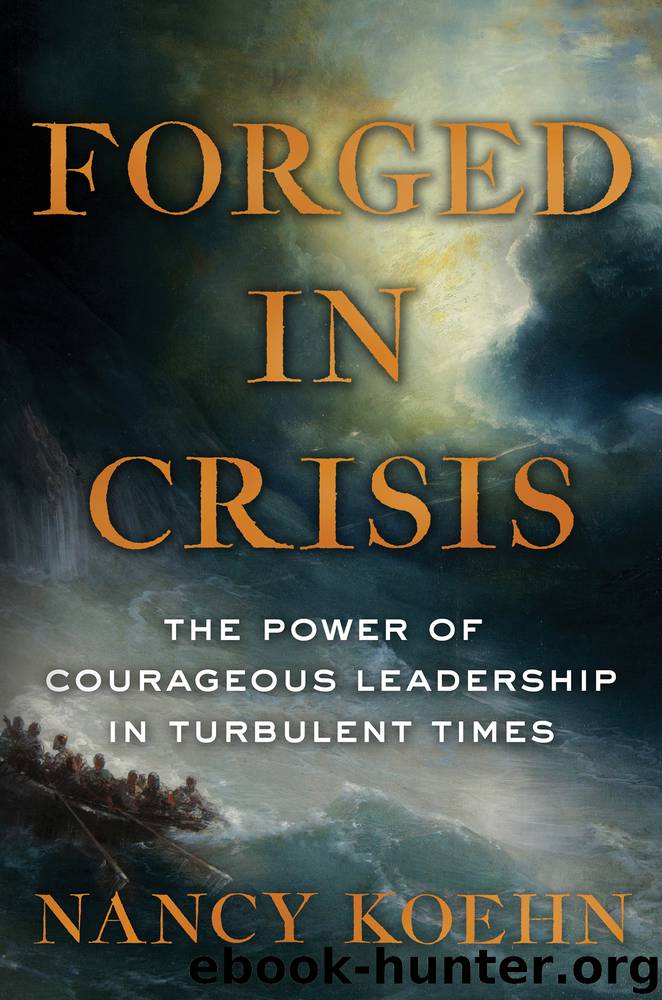
Author:Nancy Koehn
Language: eng
Format: epub
Publisher: Scribner
CHAPTER THIRTY-ONE
The World after Frederick Douglass
During his life, Frederick Douglass became the most famous African-American in the United States. As an abolitionist, an advocate for women’s rights, and a spokesman for the cause of human freedom, he made an enormous impact on the defining issue of civil liberty and particularly on the momentous events of the 1850s and early 1860s, when slavery cleaved the nation in two and provoked the Civil War.
In our own time, the importance of Frederick Douglass’s legacy and contributions is well recognized among African-Americans. But most white Americans know little about this ambitious, highly principled, and fiercely dedicated leader. Those who are familiar with the abolitionist are aware he was a fugitive slave, wrote an autobiography, and spoke out against slavery. But even they do not appreciate how penetrating his understanding of slavery was, including the role that racial prejudice and socioeconomic forces played in keeping it in place. Today, few Americans realize that this understanding helped Douglass to see—years before contemporaries such as Abraham Lincoln—that it was likely to require armed conflict to destroy such a powerful, entrenched institution.
During the middle decades of the nineteenth century, the black leader used this understanding to play a pivotal role in the struggle to end human bondage, urging ordinary citizens, other reformers, and politicians—particularly the president—to battle slavery with every available resource. As soon as the Civil War broke out, Douglass worked to define the conflict as one to eradicate slavery. Using his newspaper, the lecture circuit, and his political connections, he continued to push this perspective to the center of national debate. For almost two years, he doubted the Lincoln administration would embrace and act on what he saw as the animating purpose of the war. But in September 1862, when the president issued the Emancipation Proclamation, Douglass and many other abolitionists realized that they’d achieved a tremendously important victory: going forward, the war would be fought to extinguish slavery and transform the Union.
Douglass hoped this transformation would encompass full citizenship and equality for black Americans. Toward this end, he fought for black soldiers, lobbying government officials to enlist—and then pay and promote—them on the same terms as whites. When the conflict ended, the reformer worked to desegregate public schools, create economic opportunities for African-Americans, and secure the right to vote for blacks and women.
Through the lens of historical hindsight, we can see that Douglass relied on his keen vision, steadfast resolution, and moral judgment to articulate slavery as a terrible contradiction at the heart of the republic. He realized that slavery and the racial discrimination that underlay it contaminated whites as well as blacks and damaged the fabric of the nation. At an even deeper level, he recognized that Americans (or any other people) couldn’t become all they might in the presence of widespread prejudice against their fellow citizens. In his consistent ability to frame the stakes of these issues, his leadership anticipated the work of Martin Luther King Jr., Nelson Mandela, Gloria Steinem, and other modern activists.
Download
This site does not store any files on its server. We only index and link to content provided by other sites. Please contact the content providers to delete copyright contents if any and email us, we'll remove relevant links or contents immediately.
Waking Up in Heaven: A True Story of Brokenness, Heaven, and Life Again by McVea Crystal & Tresniowski Alex(37768)
Empire of the Sikhs by Patwant Singh(23058)
We're Going to Need More Wine by Gabrielle Union(19020)
Hans Sturm: A Soldier's Odyssey on the Eastern Front by Gordon Williamson(18555)
Leonardo da Vinci by Walter Isaacson(13292)
The Radium Girls by Kate Moore(12003)
Tools of Titans by Timothy Ferriss(8346)
Educated by Tara Westover(8033)
How to Be a Bawse: A Guide to Conquering Life by Lilly Singh(7458)
Permanent Record by Edward Snowden(5812)
The Last Black Unicorn by Tiffany Haddish(5617)
The Rise and Fall of Senator Joe McCarthy by James Cross Giblin(5259)
Promise Me, Dad by Joe Biden(5130)
The Wind in My Hair by Masih Alinejad(5070)
A Higher Loyalty: Truth, Lies, and Leadership by James Comey(4937)
The Crown by Robert Lacey(4791)
The Iron Duke by The Iron Duke(4337)
Joan of Arc by Mary Gordon(4080)
Stalin by Stephen Kotkin(3940)
